Disruptive Marketing by Geoffrey Colon
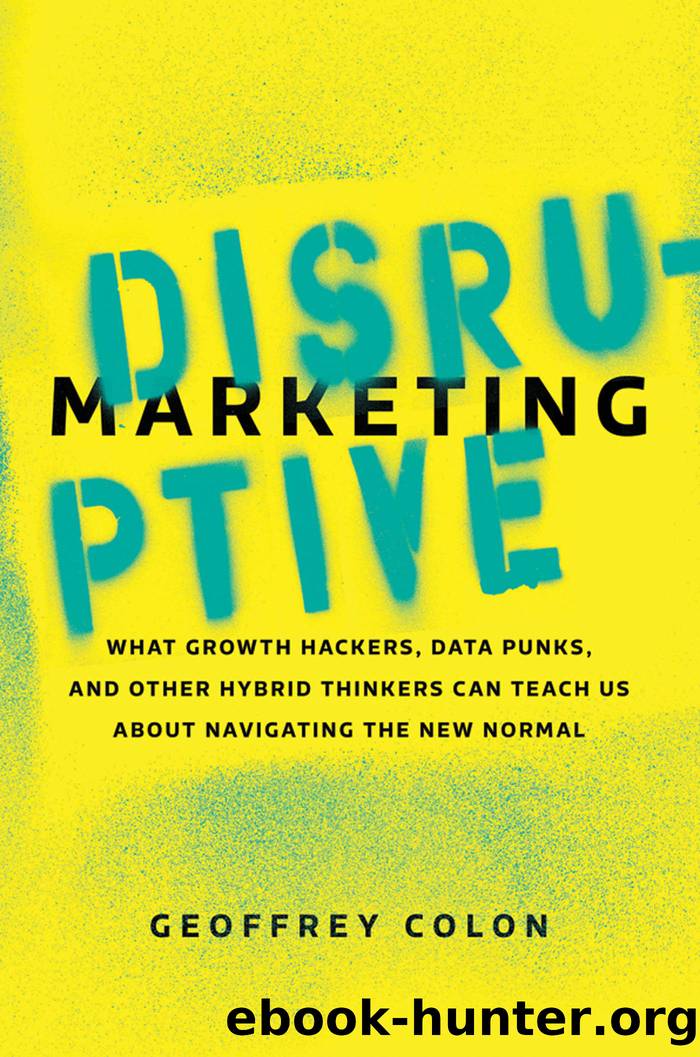
Author:Geoffrey Colon
Language: eng
Format: epub
Publisher: AMACOM
Published: 2016-09-14T16:00:00+00:00
Geoffrey Colon
@djgeoffe
In the near future, orgs with people not rooted in bias by being close to the product will be the norm. #disruptivefm
2:39 AM—29 Feb 2016
In the agency world, most employees are treated as temporary. In this way, employees stay on top of their game with out-of-the-box ideas. This is essential in an economy based on creativity and imagination.
Granted, many vibrant economies, such as that of the United States, depend on permanent workers who receive generous benefits packages that include health care and retirement plans. Even though disruptive marketing is best when generalist professionals are temporary, our current pro-austerity system doesn’t provide well for that. Nevertheless, the temporary generalist model works best for a disruptive marketing organization.
Contrary to what some believe, companies hiring temporary or contingent workers isn’t a new model that arose out of corporate cost-cutting in the wake of the 2008 Great Recession. The practice of using independent contractors has roots that go back centuries. Indeed, there was a time when all workers were essentially “contingent workers,” who hired themselves out to employers to perform a job or a service for a matter of hours, weeks, or even years, depending on the scale of the project. This changed with the industrial revolution, when manufacturers needed workers with specialized skills and so they increasingly began to hire full-time employees to work exclusively for their companies.
The assembly line was the main impetus for growth in permanent workers. Businesses ran on the economics of supply and demand, which included the labor pool. When the United States emerged from World War II with a surplus of labor and great demand for consumer products, there was a swing toward the corporate model, with knowledge workers as prized employees. Pushbacks in more recent years, with subsequent economics shifts and increased outsourcing, have reduced the ranks of permanent workers with cognitive knowledge, and now companies that want the best ideas need to bring in outsiders.
Not every company needs disruptive marketers, but when and if one does, having an old-style marketing department that is filled with entrenched specialists unwilling to execute new ideas won’t help it reach that goal. The flexibility of temporary marketers is an advantage to these companies.
Download
This site does not store any files on its server. We only index and link to content provided by other sites. Please contact the content providers to delete copyright contents if any and email us, we'll remove relevant links or contents immediately.
The Brazilian Economy since the Great Financial Crisis of 20072008 by Philip Arestis Carolina Troncoso Baltar & Daniela Magalhães Prates(351685)
International Integration of the Brazilian Economy by Elias C. Grivoyannis(111543)
The Art of Coaching by Elena Aguilar(53587)
Flexible Working by Dale Gemma;(23349)
How to Stop Living Paycheck to Paycheck by Avery Breyer(19824)
Thinking, Fast and Slow by Kahneman Daniel(12501)
The Acquirer's Multiple: How the Billionaire Contrarians of Deep Value Beat the Market by Tobias Carlisle(12421)
The Radium Girls by Kate Moore(12163)
The Art of Thinking Clearly by Rolf Dobelli(10688)
Hit Refresh by Satya Nadella(9236)
The Compound Effect by Darren Hardy(9134)
Tools of Titans by Timothy Ferriss(8568)
Atomic Habits: Tiny Changes, Remarkable Results by James Clear(8488)
Turbulence by E. J. Noyes(8182)
A Court of Wings and Ruin by Sarah J. Maas(8083)
Change Your Questions, Change Your Life by Marilee Adams(7914)
Nudge - Improving Decisions about Health, Wealth, and Happiness by Thaler Sunstein(7834)
How to Be a Bawse: A Guide to Conquering Life by Lilly Singh(7598)
Win Bigly by Scott Adams(7319)
